
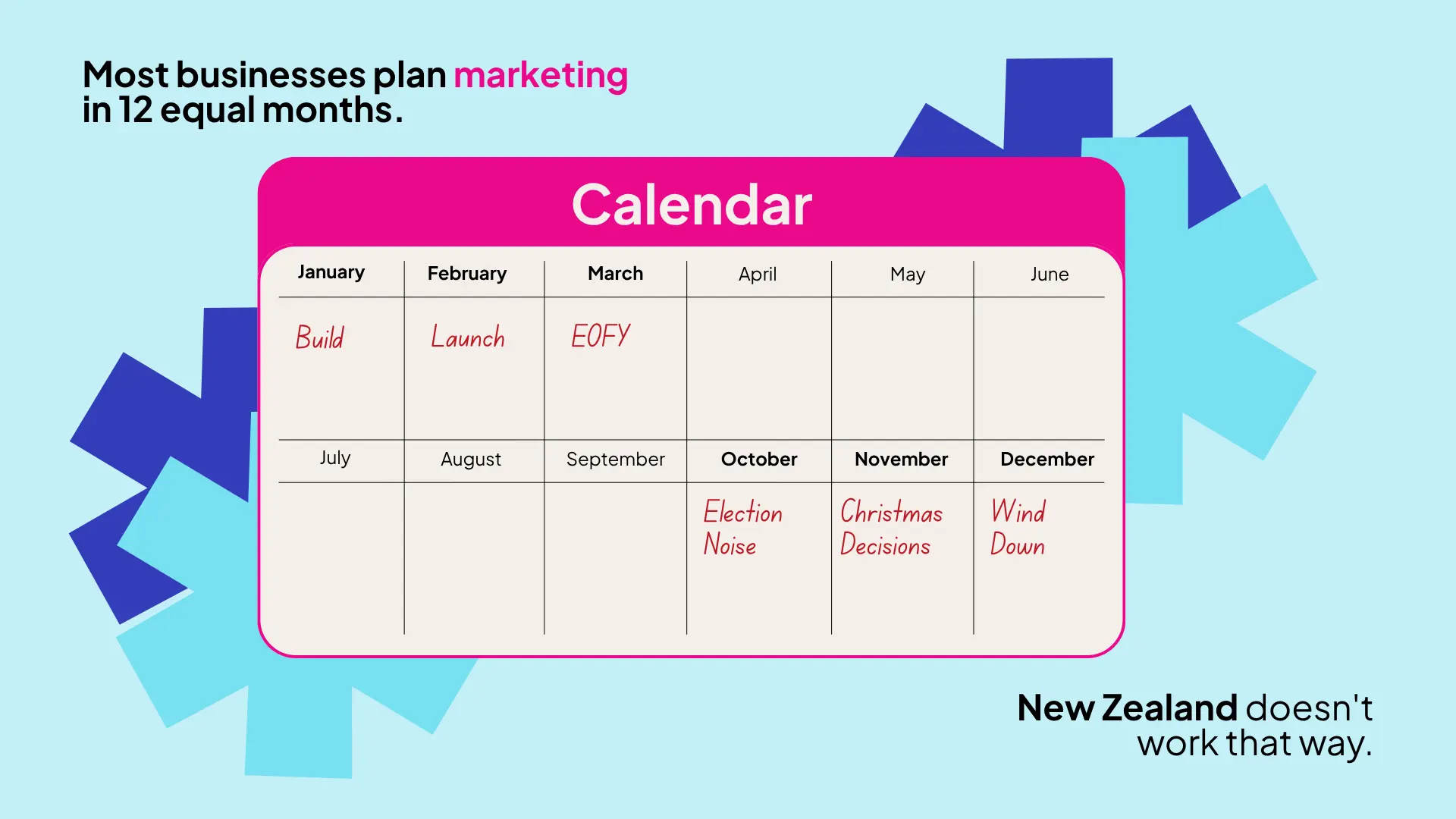
Most businesses here plan marketing in twelve equal months. There is no such thing. The New Zealand year has a shape, and if you ignore it you spend your budget pushing against months that were never going to give you anything back.
How the year actually runs
- December goes quiet from about the middle of the month
- January is a write off in most sectors, whatever anyone tells you
- February is the panic month, when every business in your category bids for the same attention at the same time
- March runs hard into the end of the financial year
- Winter slumps in most consumer categories and lifts in others
- October and November are meant to decide your Christmas, and most businesses notice too late
This year October has something else in it. An election campaign takes over every feed, every news cycle and every conversation for weeks. Attention goes political, ad inventory tightens, and a lot of businesses quietly stall on decisions until they know how things land. Add that to a December wind down and you have a very short run at Christmas with a long tail of hesitation either side of it. Anything you want landing in the last quarter needs to be built and live before the noise starts, not after.
None of this is news to anyone who has run a business here for a decade. What surprises people is how much of it can be turned to their advantage. The businesses that grow through a flat year are not working harder in the busy months. They are using the quiet ones properly.
What that looks like in practice
- January is build time, not dead time. Strategy done, creative made, website fixed, content banked, so February is a launch and not a scramble
- Your Christmas campaign is finished and scheduled before October, rather than competing with a general election for oxygen
- The slow stretch in your category is the cheapest attention you will buy all year, because your competitors have all gone quiet
The bigger issue is what a New Zealand calendar does to a business that only sells into New Zealand. When your entire revenue rides on one market, one set of seasons, one economy and one election cycle, a soft year is not something you can outwork. That is the point at which the smart move stops being a better campaign and starts being a bigger map.
We market a place before you open in it
This is the work we like most. When a client is looking at Australia, or a second region, or a customer segment they have never sold to, we do not wait for the doors to open before we start marketing. We build presence in that market first.
- Search visibility, so people looking for what you do find you before you have a local address
- Content and social that establish you as a known name rather than a new arrival
- Paid campaigns testing which message actually lands there, because what works in Auckland does not automatically work in Brisbane
It is far cheaper to learn that with a test budget than with a lease. By the time our clients open in a new market, that market already knows who they are. Demand exists before day one instead of being built from zero while overheads run. It also means a quiet New Zealand October is no longer the whole story, because Australia is not having your election.
Diversification is what makes a business durable. Different markets, different seasons, different customer bases, so a slow quarter in one place is covered by a strong one somewhere else. That is not a campaign decision. It is a strategy decision, and it needs making twelve months before you need the result.
So look at your next year honestly. Which months will genuinely deliver, which ones have you been wasting, and is your entire business riding on one market and one season? If it is, the time to fix that is now, while things are steady, not later when they are not.
If you are thinking about a new market, a new region, or simply a year that does not have four dead months in it, that is the conversation we want to have.
